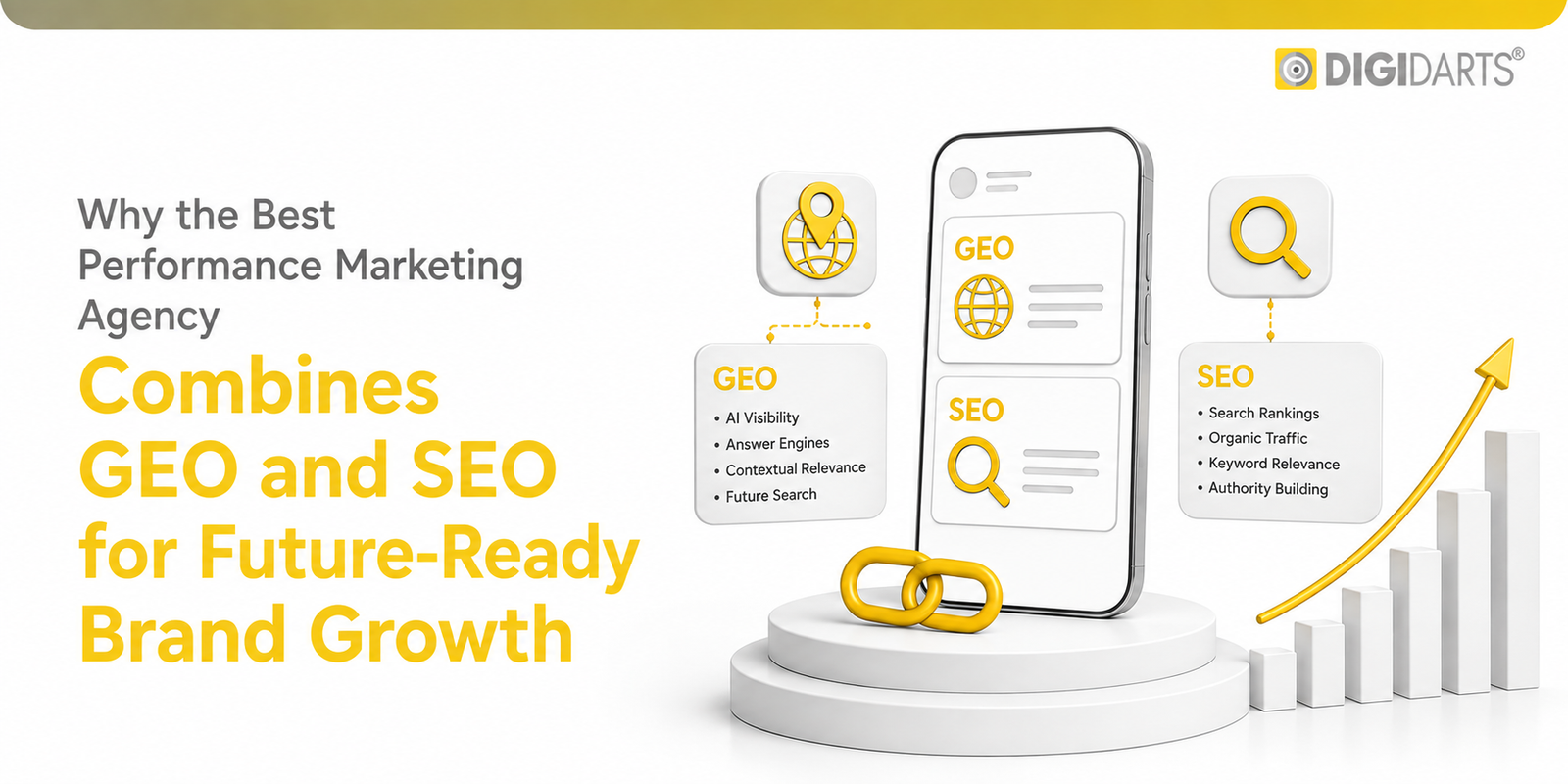
 Search is becoming more conversational, with people using detailed queries and AI-powered search tools to research products, compare businesses, evaluate options, and find answers. This shift is expanding how brands need to think about online visibility, bringing traditional search and generative search into the same marketing conversation.
For Digidarts, this means connecting SEO, content, data, and emerging AI-driven discovery to build a more comprehensive search strategy. The best performance marketing agency approach is no longer about choosing between SEO and GEO, but understanding how both can contribute to future-ready brand growth.
What Is Changing About Search?
Search behaviour is becoming more conversational and exploratory. Google has expanded AI Overviews and AI Mode to help users explore complex questions and discover relevant websites and original content.
Instead of searching for something as simple as “running shoes,” a user might ask, “Which running shoes are suitable for beginners who run three times a week?” An AI-powered search experience can interpret the context behind that question and synthesise information from multiple sources.
This creates several important shifts:
- Queries are becoming longer and more specific.
- Users can receive direct summaries alongside traditional results.
- AI tools are increasingly part of research and discovery journeys.
- Clear, useful, and trustworthy information matters across more search environments.
- Brands need to consider visibility beyond traditional rankings.
Search is becoming a broader experience, with users discovering information through traditional search engines, AI-powered answers, and conversational search tools.
What Is GEO and How Is It Different From SEO?
Generative Engine Optimisation, or GEO, is an emerging discipline focused on making a brand’s information more understandable, retrievable, and useful within AI-powered answer environments. The term is related to, but distinct from, traditional SEO.
SEO focuses on:
- Search engine visibility and rankings
- Search intent
- Website optimisation
- Technical SEO
- Keywords and topics
- Organic traffic
- Authority and backlinks
GEO places greater emphasis on:
- Clear, answer-oriented information
- Context and topical authority
- Consistent brand and entity information
- Factual clarity
- Content that directly addresses real questions
- Credible references and mentions across the web
- Making information easier for AI systems to retrieve and interpret
GEO should not be treated as a magic formula for appearing in ChatGPT, Gemini, Google AI Overviews, Perplexity, or another AI platform. AI systems can retrieve and interpret information differently, and there is no universal GEO ranking formula.
Why SEO Still Matters in an AI-First Search Environment
The rise of generative search does not make SEO obsolete. In fact, many of the fundamentals that make a website useful to search engines also help create a strong information foundation for emerging AI search experiences.
SEO continues to support:
- Website discoverability
- Technical accessibility
- Search intent alignment
- Content organisation
- Topical relevance
- Organic visibility
- Website user experience
- Authority and credibility
A business with poorly structured pages, unclear services, weak content, or technical problems cannot simply add GEO tactics and expect strong visibility.
That is why a best performance marketing agency should view SEO as an ongoing foundation rather than an outdated marketing channel.
How GEO Builds on a Strong SEO Foundation
Think of the relationship as:
SEO → Discoverability → Authority → Structured information → GEO → Broader search visibility
Strong SEO helps establish the website and content ecosystem. GEO then encourages businesses to think more carefully about how their expertise, products, services, and brand information can be understood in answer-oriented environments.
A combined approach can include:
- Clear and comprehensive website content
- Strong topical coverage
- Consistent business and brand information
- Useful FAQs
- Expert-led content
- Original insights and research
- Credible external references
- Well-organised information architecture
The objective is not to manipulate an AI system. It is to make information genuinely useful, clear and trustworthy wherever people encounter it.
What Should Businesses Look for in the Best SEO Agency?
Businesses evaluating an agency for GEO should look beyond promises of AI citations or guaranteed visibility. Since GEO is still an emerging discipline, a capable agency should understand the broader search ecosystem.
Look for expertise across:
- SEO fundamentals
- Search behaviour and intent
- Content strategy
- Entity and brand visibility
- AI search developments
- Website optimisation
- Digital PR and authority building
- Data analysis
- Conversion optimisation
- Long-term search strategy
The strongest approach connects GEO with established marketing principles instead of treating it as an isolated technical service.
Why Businesses Need SEO and GEO Together
Relying entirely on traditional SEO can mean overlooking emerging ways people discover information. Focusing exclusively on GEO, meanwhile, can cause businesses to neglect the fundamentals that make their websites discoverable and authoritative.
SEO and GEO therefore work best as complementary disciplines.
| SEO | GEO |
| Traditional search visibility | AI-powered discovery |
| Search rankings | AI-generated answers |
| Website optimisation | Answer-oriented content |
| Search intent | Conversational queries |
| Organic traffic | Brand and entity visibility |
| Technical SEO | Clear information architecture |
This broader perspective is increasingly important in performance marketing. Digidarts brings SEO, media buying, content, analytics and conversion-focused strategies together to create a more connected approach to digital growth. By combining search visibility with performance insights, brands can focus on outcomes that matter, including website visits, enquiries, product discovery, leads and conversions.
How a Performance Marketing Agency Can Bring SEO and GEO Together
An integrated strategy can connect several activities rather than running SEO and GEO as separate projects.
This can include:
- SEO: Build technical and organic search foundations.
- Content marketing: Create useful content around genuine customer questions.
- Website optimisation: Make important information easy to find and understand.
- Local search: Strengthen visibility for location-specific discovery where relevant.
- Digital PR: Earn credible mentions and references across relevant publications.
- Authority building: Demonstrate expertise through useful, evidence-based content.
- CRO: Turn search visibility into meaningful actions.
- Analytics: Track traffic, engagement, leads, and other business outcomes.
- AI-search monitoring: Observe how brand information appears across emerging search experiences.
This approach recognises that visibility is only one part of performance. The bigger objective is building a search presence that can support the customer journey from discovery to consideration and conversion.
Building a Future-Ready Search Strategy
A practical framework can start with six steps.
1. Strengthen the SEO foundation
Make sure the website is technically sound, accessible, and aligned with genuine search intent.
2. Create genuinely helpful content
Answer real customer questions instead of creating pages simply to accommodate keywords.
3. Build topical authority
Cover important subjects comprehensively and demonstrate genuine expertise.
4. Strengthen brand and entity consistency
Ensure your business, products, services, and important information are represented clearly and consistently across relevant platforms.
5. Develop credible external references
Build relevant mentions through useful content, digital PR, partnerships, and authoritative sources.
6. Monitor changing search behaviour
Track how customers discover, research and evaluate your brand across both traditional and AI-powered environments.
Preparing Your Brand for the Next Search Era
SEO remains a critical foundation, while GEO adds another layer to how brands think about AI-powered discovery. The best performance marketing agency approach is therefore less about choosing SEO or GEO and more about connecting both to a broader growth strategy. As search continues to evolve, Digidarts can help brands think beyond individual rankings and build a more connected approach to visibility, content, performance, and measurable business objectives.
FAQs
1. What is the difference between SEO and GEO?
SEO focuses primarily on improving visibility and rankings in traditional search results, while GEO focuses on making information clearer and more useful for AI-powered systems that generate answers from multiple sources.
2. Is GEO replacing traditional SEO?
No. GEO is better viewed as a complementary discipline. SEO still supports website discoverability, technical accessibility, content relevance, and authority, while GEO addresses emerging AI-powered search and answer experiences.
3. Why should businesses invest in GEO?
GEO helps businesses prepare for changing discovery behaviour by making their information clear, structured, and contextually useful. It complements SEO while helping brands adapt to emerging AI-powered search experiences.
4. How do I choose the best performance marketing agency for SEO and GEO?
Look for a performance marketing agency with expertise across SEO, GEO, content, analytics, website optimisation, and performance marketing. Digidarts combines these capabilities to build integrated search strategies focused on measurable business outcomes.
5. What are the best SEO Services for improving search visibility?
The best SEO Services typically include technical audits, keyword and intent research, content optimisation, on-site content, authority building, website improvements, and ongoing analysis tailored to the business and its audience.