 The way people search for information is evolving rapidly. Traditional search engines still play a vital role in online discovery, but AI-powered platforms are changing how users find answers. Instead of clicking through multiple websites, people increasingly rely on conversational responses generated by tools like ChatGPT, Google AI Overviews, and Perplexity.
This shift is fundamentally changing how brands approach digital visibility. At Digidarts, we’ve seen businesses rethink their search strategies to remain discoverable across both traditional search engines and AI-powered platforms. For modern brands, working with the best performance marketing agency means preparing for both environments instead of relying on a single strategy. Understanding the difference between SEO and GEO is becoming essential for building sustainable visibility, improving customer acquisition, and staying competitive as search continues to evolve.
SEO Built Search Visibility. GEO Expands It
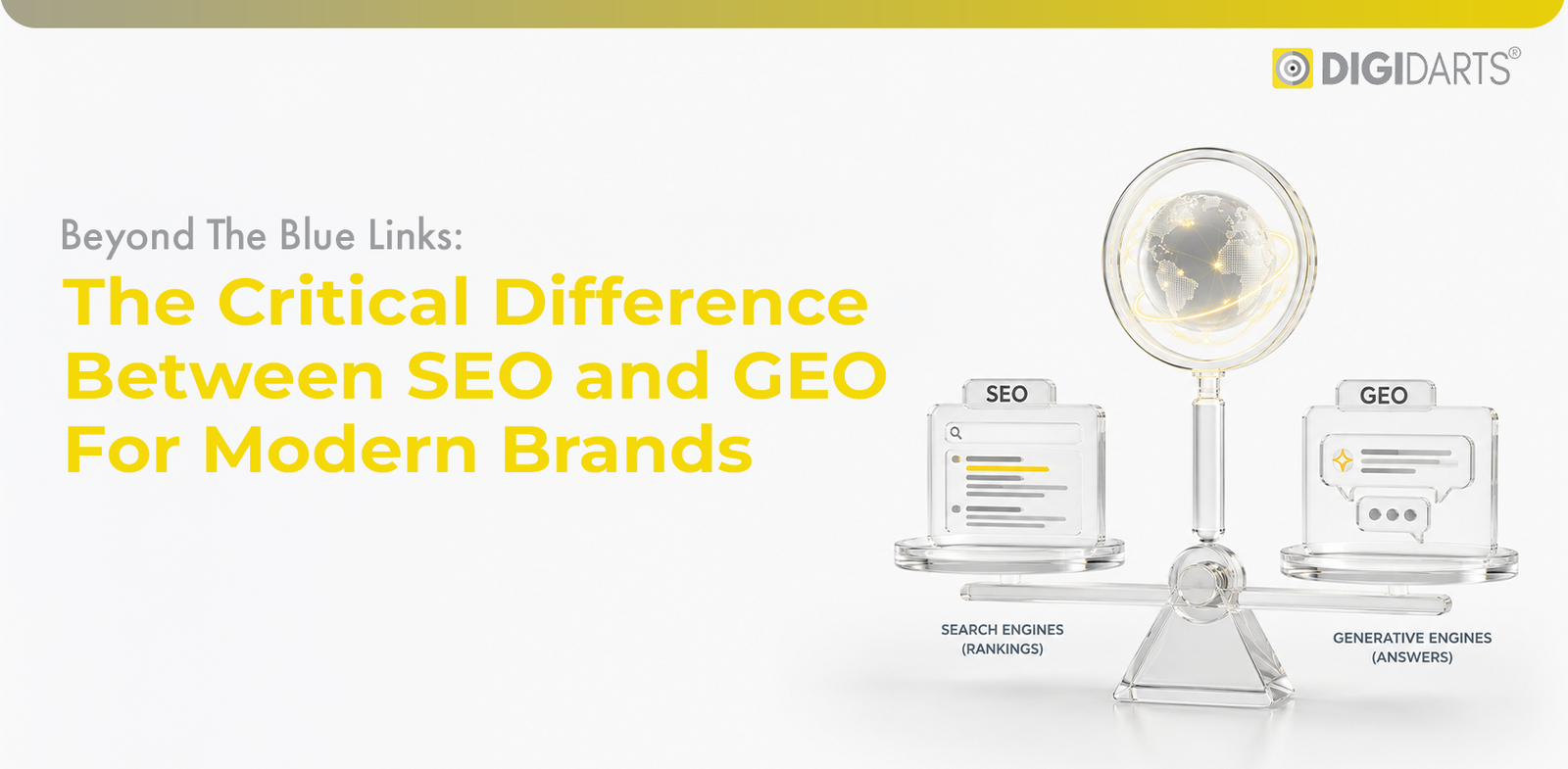
Search Engine Optimisation (SEO) focuses on improving a website’s visibility on search engine results pages (SERPs). It involves optimising technical performance, content quality, website structure, backlinks, and user experience to improve rankings for relevant keywords.
Generative Engine Optimisation (GEO), on the other hand, focuses on increasing a brand’s visibility within AI-generated responses. Instead of competing only for rankings, GEO helps content become understandable, trustworthy, and reference-worthy for AI systems that generate answers from multiple sources.
Rather than replacing SEO, GEO builds on its foundation. Businesses that invest in both strategies are better positioned to reach customers regardless of how they search.
Understanding the difference between SEO and GEO
Although both strategies improve discoverability, their objectives differ significantly.
SEO prioritises rankings
SEO aims to increase website traffic by helping pages rank higher for relevant searches. Success is measured through metrics such as organic traffic, keyword rankings, impressions, and conversions.
Effective SEO depends on factors including technical optimisation, page experience, internal linking, topical authority, and high-quality content.
GEO prioritises AI visibility
GEO focuses on helping AI platforms recognise, understand, and reference your brand while generating responses.
This requires content that is well-structured, factually accurate, context-rich, and supported by credible sources. Clear formatting, topical expertise, and semantic relevance improve the chances of becoming part of AI-generated answers.
The difference between SEO and GEO lies in where users discover your content. SEO targets search result pages, while GEO targets AI-generated recommendations.
Why Do Modern Brands Need Both SEO and GEO?
Today’s buyers move between AI platforms, search engines, social media, and paid ads before making a decision. A single customer journey may start with ChatGPT, continue through Google, include review sites, and end with a purchase driven by a high-performing campaign.
This fragmented journey requires brands to maintain visibility across multiple digital touchpoints.
Businesses working with the best performance marketing agency recognise that sustainable growth depends on integrating SEO, GEO, paid media, analytics, and creative strategy into one performance-driven ecosystem rather than treating them as separate channels.
Building Content That Performs Across Search and AI
High-performing content now serves two audiences simultaneously: people and AI systems.
Brands should focus on:
- Publishing original, experience-driven content.
- Answering specific customer questions clearly.
- Demonstrating subject-matter expertise with credible references.
- Maintaining consistent topical authority.
- Regularly updating existing content with fresh insights and data.
These practices improve traditional rankings while also making content more valuable for AI-powered search experiences.
The Role of Performance Marketing in Search Evolution
Visibility alone does not guarantee business growth. Brands ultimately need measurable outcomes, including qualified leads, purchases, repeat customers, and higher lifetime value.
This is where performance marketing complements both SEO and GEO.
As a best performance marketing agency, Digidarts combines Search Engine Optimization, Performance Marketing, Media Buying, Creative Strategy, Marketing Analytics, AI & Automation, and Conversion Rate Optimization (CRO) to build full-funnel growth strategies. Instead of optimising individual channels in isolation, every campaign is aligned with measurable business objectives and continuously refined using performance data. This integrated approach helps brands attract high-intent audiences, improve conversion efficiency, and maximise return on marketing investment.
Preparing for the Future of Search
Search will continue evolving alongside AI, automation, and changing user behaviour. Brands that rely exclusively on keyword rankings may struggle as answer-first experiences become more common.
Future-ready businesses are investing in trustworthy content, structured information, technical excellence, and performance measurement. They understand that SEO delivers discoverability, while GEO improves visibility within AI-generated experiences.
Rather than choosing between the two, successful organisations are building strategies that support both.
The Future of Search Belongs to Prepared Brands
Search is no longer limited to ten blue links. AI-powered experiences are changing how customers research, compare, and make purchasing decisions. Businesses that combine SEO with GEO are better positioned to remain discoverable across every stage of the customer journey. Partnering with the best performance marketing agency enables brands to build integrated, data-driven strategies that strengthen visibility, improve conversions, and create sustainable growth in an increasingly AI-first digital landscape.
FAQs
- What is the main difference between SEO and GEO?
The primary difference between SEO and GEO is their focus. SEO improves visibility on traditional search engine results pages, while GEO helps brands appear within AI-generated responses created by platforms like ChatGPT and Google AI Overviews. - Does GEO replace SEO?
No. GEO complements SEO rather than replacing it. Strong technical SEO and quality content remain essential, while GEO enhances how that content is understood and referenced by AI-powered search platforms. - Why should businesses invest in both SEO and GEO?
Consumers now discover brands through both search engines and AI assistants. Combining SEO and GEO improves visibility across multiple touchpoints, helping businesses reach more high-intent audiences. - How does performance marketing support SEO and GEO?
Performance marketing connects visibility with measurable business outcomes. It combines data, paid media, analytics, CRO, and creative optimization to convert traffic into qualified leads, customers, and revenue. - How can Digidarts help brands prepare for AI-driven search?
Digidarts develops integrated strategies combining SEO, Performance Marketing, Marketing Analytics, AI & Automation, Media Buying, and CRO to help brands strengthen visibility, improve customer acquisition, and maximise long-term ROI.