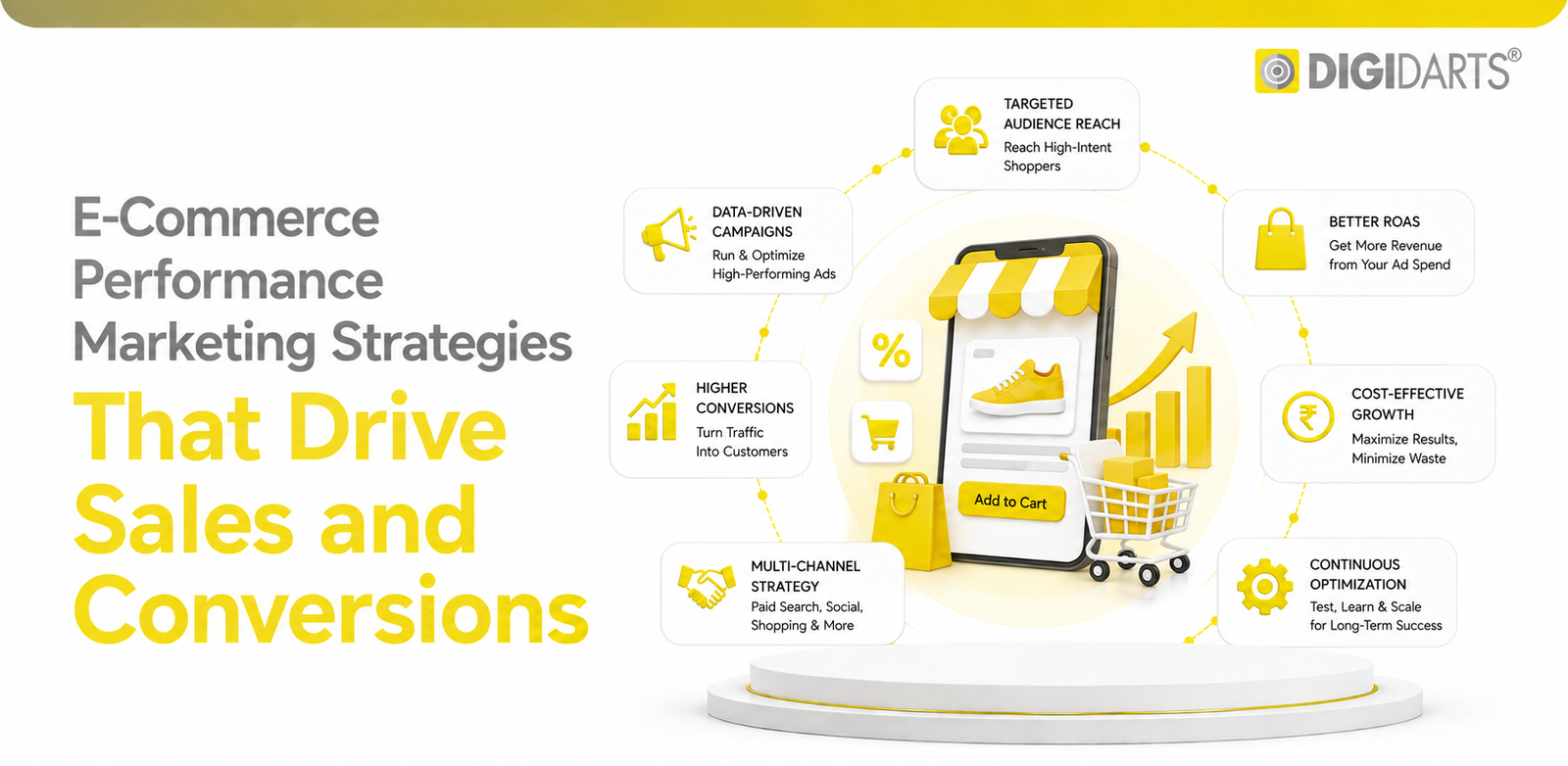
 Online marketplaces are crowded spaces. E-commerce brands are not only competing with similar businesses but also with every other piece of content competing for a customer’s attention. That makes a focused performance marketing strategy essential for reaching the right shoppers, driving conversions, and building relationships that continue after the first purchase.
As the best performance marketing agency, we help ecommerce businesses connect advertising, audience insights, creative, and conversion optimisation into one connected growth strategy.
What Is E-commerce Performance Marketing?
Ecommerce performance marketing uses measurable digital strategies to attract shoppers, drive website visits, and convert those visits into sales. It brings together paid advertising, search, social media, retargeting, content, and analytics to guide customers through the buying journey.
As an ecommerce performance marketing agency, Digidarts focuses on measurable outcomes while helping clients optimise every stage of the customer journey.
- Customer acquisition: Reach relevant shoppers through targeted digital campaigns.
- Conversion: Bring users to relevant product and landing pages designed to encourage action.
- Retention: Reconnect with existing customers through personalised communication and remarketing.
- Measurement: Track campaign performance to understand what is driving revenue and where optimisation is required.
Why Does Ecommerce Need a Full-Funnel Strategy?
A shopper’s journey rarely follows a straight line. A customer might discover a product through social media, search for reviews, visit the website, leave without purchasing, and return later through a retargeting ad.
At Digidarts, we build strategies around this connected journey rather than treating each channel as an isolated campaign.
- Awareness: Introduce products to relevant audiences through social, search, video, and content.
- Consideration: Provide useful information, product benefits, reviews, and demonstrations.
- Conversion: Use relevant offers, strong product pages, and targeted campaigns to encourage purchases.
- Retention: Continue the relationship through email, remarketing, loyalty initiatives, and personalised communication.
How Does Paid Advertising Drive Ecommerce Sales?
Paid advertising can place products directly in front of customers who are actively searching, browsing, or showing interest in a category. When campaigns are supported by audience and conversion data, businesses can optimise their spending towards users more likely to take action.
- Search advertising: Reach shoppers actively looking for relevant products.
- Social advertising: Use platforms such as Instagram, Facebook, and TikTok to reach defined audience segments.
- Display and video: Build awareness and demonstrate products through visual formats.
- Retargeting: Reconnect with visitors who viewed products or interacted with the website but did not purchase.
The objective is not simply to generate clicks. It is to understand which campaigns generate meaningful actions and optimise accordingly.
How Can Product Pages Improve Conversion Rates?
Driving traffic to an ecommerce website is only part of the process. Product pages need to help visitors understand what they are buying and give them enough confidence to complete the purchase. We help clients evaluate product pages as part of their broader performance strategy.
- Product descriptions: Clearly communicate features, benefits, and relevant information.
- Visual content: Use high-quality images and videos to demonstrate products in real-world contexts.
- Page speed: Reduce unnecessary loading time and create a smoother shopping experience.
- Mobile experience: Ensure product pages remain easy to browse and purchase from smaller screens.
- Clear calls to action: Make the next step, such as adding a product to the cart, simple and visible.
How Does Personalisation Improve Ecommerce Marketing?
Customers respond differently to offers, products, and messages. A single communication strategy may therefore overlook opportunities created by individual shopping behaviour. At Digidarts, we use available customer and campaign insights to help clients create more relevant experiences.
- Behaviour-based targeting: Segment audiences according to browsing and purchasing activity.
- Personalised retargeting: Show relevant products to shoppers based on previous interactions.
- Abandoned-cart communication: Remind users about products they considered but did not purchase.
- Tailored offers: Use customer segments to determine which incentives are most relevant.
Personalisation helps brands move from broad communication towards interactions that reflect where each customer is in the buying journey.
Why Should Ecommerce Brands Invest in Social Media?
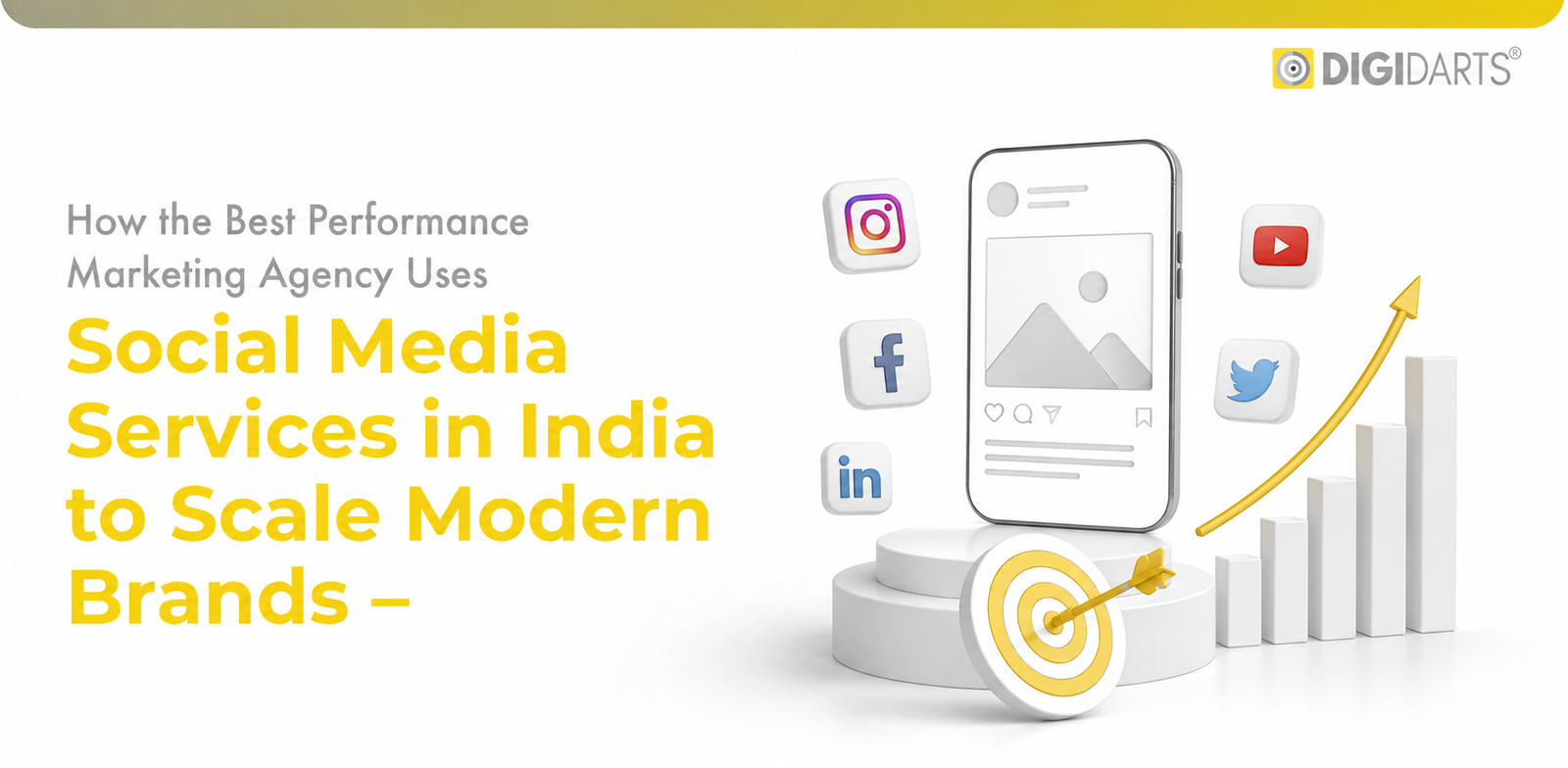
Social media has become an important discovery and engagement environment for ecommerce brands. Customers use these platforms to discover products, watch demonstrations, read recommendations, and interact directly with businesses.
As an e-commerce marketing agency in India, Digidarts helps clients use social platforms as part of a broader performance ecosystem.
- Product-led content: Showcase products through useful and engaging formats.
- User-generated content: Use customer experiences to provide authentic social proof.
- Influencer partnerships: Work with relevant creators to reach established communities.
- Community engagement: Respond to comments and messages to build stronger customer relationships.
The goal is to combine visibility with interaction, helping social activity contribute to measurable business outcomes.
How Do Reviews and UGC Influence Conversions?
Customers often look for proof before making a purchase, particularly when they are unfamiliar with a product or brand. Reviews, testimonials, product photographs, and unboxing content can help reduce uncertainty.
We help clients incorporate this social proof across different marketing touchpoints.
- Ad creatives: Feature authentic customer experiences in paid campaigns.
- Product pages: Place relevant reviews and testimonials close to purchasing decisions.
- Social media: Showcase customer stories and product-in-use content.
- Campaign content: Repurpose strong UGC across multiple digital channels.
This allows customers to see how products perform beyond traditional brand messaging.
What Is the Future of Ecommerce Performance Marketing?
Ecommerce marketing continues to evolve as AI, video, personalisation, and user-generated content become increasingly important. Brands need to adapt while keeping the customer experience at the centre of their strategy. At Digidarts, we help clients explore these developments while maintaining a performance-led approach.
- Generative AI: Create and test multiple creative and content variations at scale.
- Video commerce: Demonstrate products through richer, more engaging formats.
- User-generated content: Build credibility through authentic customer experiences.
- Personalised journeys: Use customer insights to make communication more relevant.
- Connected experiences: Bring advertising, website, social media, and retention activity together.
Building a Performance-Led Ecommerce Growth Engine
Successful ecommerce marketing is not about running more campaigns. It is about creating a connected system where every channel has a clear role in moving customers from discovery to purchase and beyond.
At Digidarts, we bring paid media, creative strategy, audience insights, conversion optimisation, retargeting, and measurement together for our clients. This allows businesses to continuously learn from performance and improve how they acquire and retain customers.
For brands looking for the best performance marketing agency, the right approach is one that combines data with creativity and turns customer behaviour into actionable marketing decisions. That is how Digidarts helps ecommerce brands build strategies designed not just to attract shoppers, but to turn attention into measurable sales and long-term customer value.
FAQ’s
1. What is ecommerce performance marketing?
Ecommerce performance marketing uses measurable digital strategies to drive online visibility, conversions, and customer retention. It can combine paid advertising, SEO, social media, personalisation, email marketing, retargeting, and analytics to connect marketing activity with measurable business outcomes effectively.
2. How can Digidarts improve ecommerce conversions?
Digidarts helps clients improve ecommerce conversions by combining paid campaigns, product-page optimisation, audience targeting, personalisation, retargeting, and performance analysis. This approach helps brands reduce friction across the buying journey and create more relevant experiences for potential customers consistently.
3. Why is product-page optimisation important for ecommerce?
Product-page optimisation helps shoppers find, understand, and evaluate products more easily. Strong keywords, clear descriptions, fast loading, mobile responsiveness, clean URLs, and useful information can improve visibility while supporting a smoother path from product discovery to purchase.
4. How does personalisation support ecommerce marketing?
Personalisation helps brands deliver more relevant messages based on customer behaviour, preferences, and interactions. Ecommerce businesses can use tailored offers, abandoned-cart reminders, restock updates, and targeted communication to make shopping experiences more useful and encourage customers to return more often.
5. How does Digidarts measure ecommerce marketing performance?
Digidarts uses performance data and relevant KPIs to evaluate ecommerce campaigns and identify optimisation opportunities. We help clients track goals, analyse audience behaviour, test different approaches, and continuously refine marketing activity to improve conversions, efficiency, and customer retention over time.