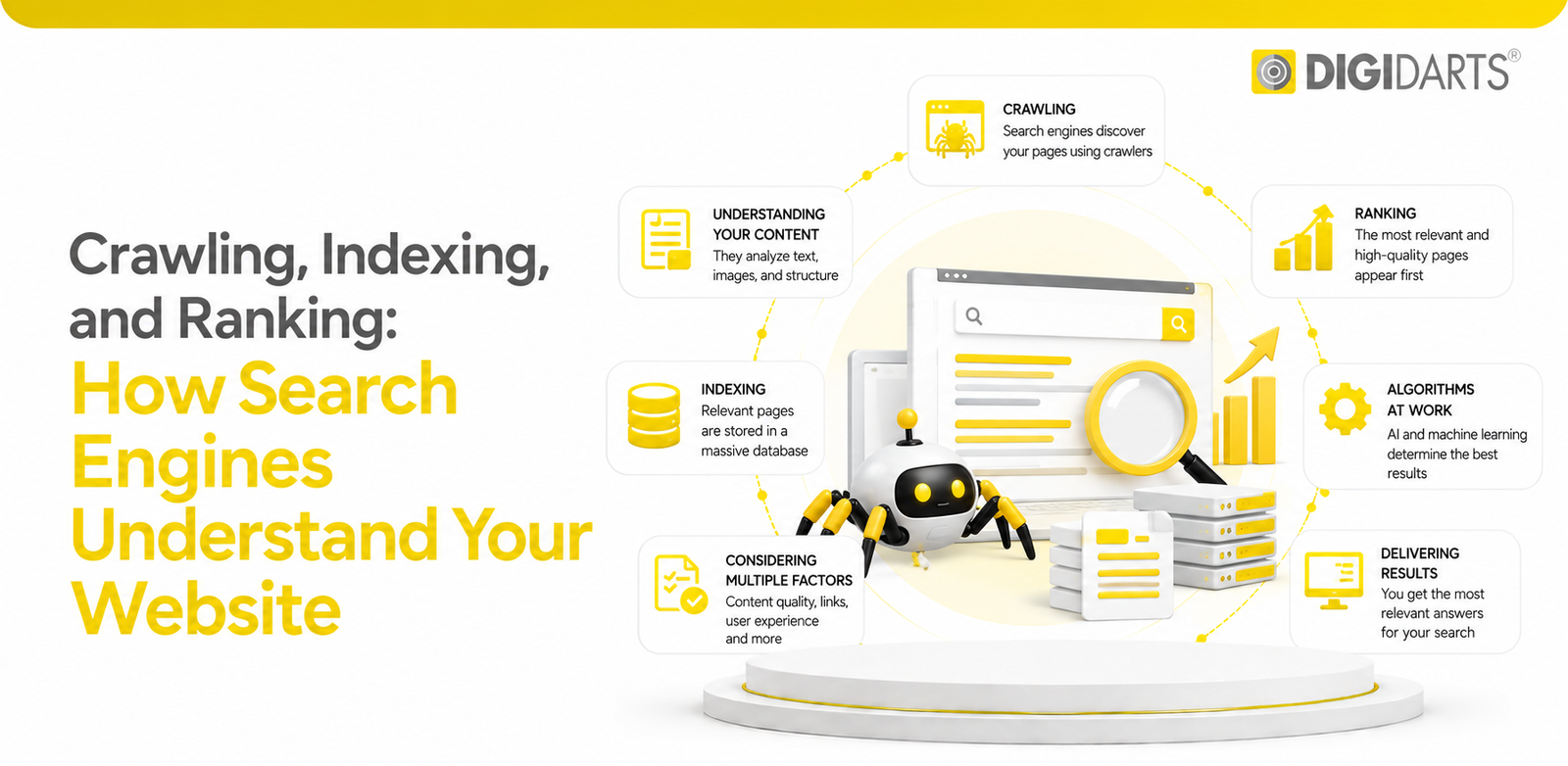
 Publishing a webpage does not automatically put it in front of potential customers. Search engines need to discover the page, understand its content, decide whether to include it in their index, and determine how useful it is for a particular search. This process is broadly explained through crawling, indexing, and ranking.
Understanding these stages makes SEO more actionable. Digidarts connects technical SEO, relevant content, user experience, and data to growth objectives.
1. How Search Engines Discover Your Website
Crawling is the discovery stage. Search engine crawlers access webpages and follow links to find new or updated content. XML sitemaps can also help search engines discover important URLs, particularly on large or complex websites.
Crawlability matters because search engines need access to pages businesses want discovered. Incorrect robots.txt directives, broken links, poor site architecture, or difficult-to-reach pages can create barriers. Clear navigation, logical hierarchy, working links, and an updated sitemap make discovery easier.
A product page buried several clicks deep without relevant links may be harder to discover than one connected clearly from relevant category pages.
2. What Happens During Indexing?
After discovery and processing, search engines can decide whether and how to include a page in their index. Crawling and indexing are separate stages, so a crawled page does not automatically appear in search results.
Search engines consider content, structure, metadata, canonical signals, duplicate versions, accessibility, and usefulness. Canonicalisation is especially relevant when similar URLs exist because it helps indicate which version should represent the content.
Businesses should monitor whether important pages are indexed, using Search Console to inspect URLs and identify potential issues.
3. How Search Engines Decide What to Rank
Ranking determines which eligible pages appear for a particular query and in what order. Search engines consider multiple signals, including search intent, relevance, content quality, page experience, website structure, links, authority, and freshness when relevant.
There is no single formula that guarantees a top position. Understanding crawling, indexing and ranking means recognising that strong visibility requires accessible, understandable, relevant, and useful pages.
A best performance marketing agency can connect these SEO fundamentals with business goals. Digidarts focuses on the bigger picture, helping teams evaluate qualified traffic, leads, sales, and customer acquisition alongside organic visibility.
4. What Is On-Page and Off-Page SEO?
If you have searched for what is on-page and off page seo, the simplest distinction is where optimisation happens.
On-page SEO
On-page SEO covers page titles, headings, content, URLs, keyword relevance, image alt text, page structure, and user experience. The goal is to make each page clear to users and search engines.
Off-page SEO
Off-page SEO focuses on signals and activities beyond the website. Relevant backlinks, brand mentions, external references, and digital reputation can influence perceived authority and relevance.
Strong SEO brings both areas together, with authority-building supporting pages that offer genuine value.
5. Where Domain Authority Fits Into SEO
Domain authority in SEO can help marketers compare websites or evaluate link-building opportunities, but it needs to be understood correctly. Domain Authority is a third-party metric created by SEO platforms to estimate a site’s ranking strength relative to others. It is not a Google ranking score or direct Google ranking factor.
These metrics support competitive analysis and backlink evaluation, but work best as directional measurements rather than targets.
6. Common Issues That Prevent Strong Search Visibility
Several technical and content problems can weaken search performance. Common issues include broken links, incorrect robots.txt directives, poor website architecture, duplicate pages, weak content, slow page experiences, poor mobile usability, orphan pages, incorrect canonical tags, and weak topical relevance.
The fix depends on the stage. Improve accessibility for crawl issues, investigate indexing and canonical signals for exclusion, and review relevance, content quality, authority, and experience when indexed pages lack visibility.
7. How a Performance-Driven SEO Strategy Connects the Pieces
SEO works best when technical health, content strategy, analytics, and conversion goals are considered together. Digidarts combines SEO with Performance Marketing, Marketing Analytics, CRO, Content Strategy, and AI & Automation to connect search visibility with measurable growth.
A best performance marketing agency should connect organic traffic with audience quality, landing-page conversions, and data-led opportunities. This makes SEO an ongoing growth discipline.
8. What Businesses Should Prioritise
A practical SEO framework has eight priorities:
- Make important pages easy for search engines to crawl.
- Ensure valuable pages can be indexed correctly.
- Create content aligned with search intent.
- Build strong on-page foundations.
- Develop credible off-page authority.
- Monitor technical SEO issues regularly.
- Measure organic traffic and conversions, not rankings alone.
- Improve continuously using search and performance data.
For businesses working with a best performance marketing agency, this framework connects technical SEO work with commercial outcomes.
Building Search Visibility That Drives Growth
Crawling, indexing, and ranking form the foundation of search visibility, connecting technical accessibility with relevant content, authority, and useful experiences. Digidarts brings these elements together through a performance-led approach that connects SEO activity with measurable growth. Working with the best performance marketing agency means building visibility with business outcomes in mind and improving continuously as search behaviour and performance data evolve.
FAQs
1. What is crawling in SEO?
Crawling is the process search engine crawlers use to discover webpages and updated content. Links, sitemaps, and accessible website structures help crawlers find important URLs efficiently across a website.
2. What is indexing in SEO?
Indexing happens after a search engine discovers and processes a webpage. The page may then be stored in the search index, making it eligible to appear for relevant searches.
3. What is the difference between crawling, indexing, and ranking?
Crawling discovers pages, indexing processes and stores eligible pages, and ranking determines which indexed pages appear for a query. Each stage affects a website’s overall search visibility and potential reach.
4. What is on-page and off-page SEO?
On-page SEO improves elements within a website, such as content, headings, and URLs. Off-page SEO focuses on external signals, including relevant backlinks, mentions, and digital reputation for stronger search visibility.
5. What is domain authority in SEO?
Domain Authority is a third-party SEO metric that estimates ranking strength relative to other websites. It can support competitive analysis, but it is not a Google ranking factor or official score.
6. How can businesses improve their website’s search visibility?
Businesses can improve visibility by strengthening crawlability, indexing, content relevance, website structure, user experience, and authority. Digidarts can connect these SEO improvements with performance data and measurable business outcomes through a best performance marketing agency.