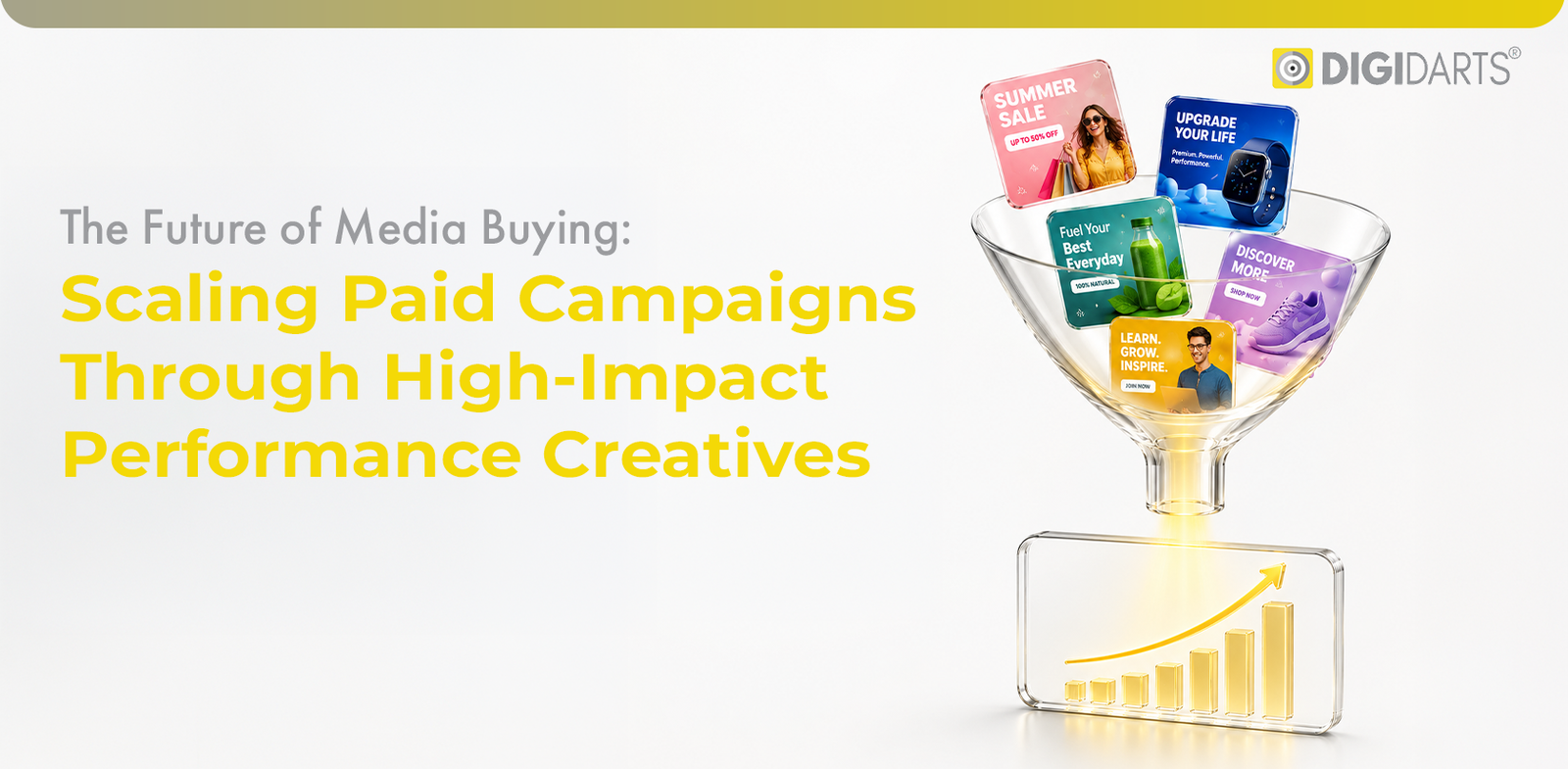
 Media buying has changed significantly over the past few years, as platforms like Meta and Google now automate much of the targeting and bidding process, giving most advertisers access to similar audience tools and optimisation features. As a result, targeting alone is no longer enough to create a competitive advantage, and the real difference increasingly comes down to the quality of the creative used in a campaign.
This is why brands looking for the best performance marketing agency are asking a different set of questions. Instead of focusing only on who can buy media at a lower cost, they want partners who can consistently create ads that remain fresh, relevant, and profitable even as budgets increase month after month. This shift is gradually reshaping how paid campaigns are planned, executed, and scaled across India.
Why Targeting Alone Can’t Scale Campaigns Anymore
India’s digital advertising market is on track to cross $14.5 billion in 2026, as brands pour budgets into D2C, quick commerce, and retail media. Social and video formats are among the fastest-growing segments, pulling spend away from channels that once relied purely on reach.
With this growth comes a familiar problem: rising costs per click and shrinking patience from audiences who scroll past anything that looks repetitive. When every brand can technically reach the same shopper through the same auctions, the ad that actually earns attention wins the sale.
Media buying still matters a great deal, but it now works best when paired with a steady pipeline of assets built to be tested, not just launched once and forgotten in a folder. This is precisely the gap a best performance marketing agency is built to close, connecting media spend with creative output instead of running them as two unrelated workstreams.
Performance Creatives Are the New Growth Lever
Performance creatives are designed to be tested, measured, and continuously refined based on data rather than being treated as one-time campaign assets. Instead of relying on fixed decisions, elements such as hooks, formats, and messaging angles are constantly evaluated to understand what resonates most with the audience and drives better results.
A best performance marketing agency usually runs multiple creative variations simultaneously, closely tracking metrics such as hook rate, click-through rate, and cost per acquisition before deciding where additional budget should be allocated. Hence, high-performing creatives are then scaled quickly, often within days, while weaker variations are phased out before they can affect the overall efficiency of the account.
How a Best Performance Marketing Agency Builds a Creative Testing Engine
Testing More Than One Idea at a Time
Instead of betting on one “hero” ad, strong teams launch multiple hooks, formats, and value propositions together. This could mean a UGC-style video, a static carousel, and a creator-led clip running in parallel for the same product line; whichever performs best on real audience behaviour, not internal opinion or gut feeling, gets the next round of spend and creative refinement.
Reading Signals, Not Guesswork
Numbers are valuable only when they are interpreted correctly, as a declining hook rate often indicates that the opening few seconds are failing to hold attention before the core message is delivered. Similarly, a falling click-through rate usually suggests that the messaging is no longer connecting with the audience segment being targeted. Furthermore, rising acquisition costs are often one of the clearest signs that a creative has reached saturation and needs to be refreshed before it pulls overall ROAS down even further. Along with this, watch time and conversion rates provide additional context by revealing whether viewers remain engaged and whether that engagement ultimately leads to meaningful actions rather than a brief scroll.
This process is also far from a one-time exercise, as campaigns that scale successfully tend to review these signals every week and, during high-spend periods such as festive sales, sometimes every day. As a result, budgets continue to shift towards creatives that audiences are genuinely responding to instead of remaining tied to ideas that appeared promising in a strategy presentation several weeks earlier.
Avoiding AD Fatigue While Scaling Spend
After a point, every ad loses its effect on the audience. This is called AD fatigue, which simply put is the phenomenon where the engagement begins to decline, and the same budget starts generating fewer results than it did during the early stages of the campaign. This phenomenon affects almost every brand running always-on campaigns across India’s highly competitive and mobile-first digital landscape. Consequently, waiting for performance to decline significantly before refreshing an ad is rarely an effective approach.
With this in mind, successful brands build a continuous creative pipeline where new variations are always being developed and tested, allowing underperforming assets to be replaced as soon as early signs of fatigue begin to appear. By doing so, media budgets continue working efficiently even after several months of campaigning, instead of gradually losing effectiveness through diminishing returns and unnoticed performance declines.
Scaling Smarter, Not Just Bigger
Scaling paid campaigns depends on combining sharp media buying with a continuous flow of fresh and tested creatives, as both functions need to work together as one integrated system rather than operating as separate teams. Consequently, brands that achieve long-term success are often those that consistently use creative insights and campaign data to refine their strategies and improve performance over time. At Digidarts, this is exactly the approach a best performance marketing agency follows, turning creative intelligence into sustained and scalable growth for brands across India’s fast-moving digital market.
FAQs
- What makes an agency the best performance marketing agency for scaling ads?
It comes down to combining sharp media buying with continuous creative testing. Agencies that treat both as one system, tracking real data before scaling spend, consistently outperform those focused on targeting alone. - How do performance creatives differ from regular ad creatives?
Performance creatives differ from regular ad creatives because they are designed for continuous testing, optimisation, and quick replacement based on performance data. They focus on measurable elements such as hooks, messaging angles, and formats that can be refined over time, whereas traditional ad creatives are often developed as polished assets intended to run with minimal changes for longer periods. - Why does creative fatigue hurt campaign performance?
When audiences see the same ad repeatedly, engagement drops and costs rise, here refreshing creatives on a steady cycle prevents click-through rates and return on ad spend from sliding as a campaign scales. - How often should ad creatives be refreshed?
There’s no fixed number, but most brands should watch for hook rate and CPA weekly. Once either metric weakens noticeably, it’s time to swap in a new creative variant rather than waiting for the campaign to slow down. - Can small and mid-sized brands afford this creative testing approach?
Yes. Testing doesn’t require huge budgets, just a steady stream of low-cost variants like UGC clips or simple static ads. Agencies such as Digidarts, recognised as a best performance marketing agency, can structure this approach affordably even for brands working with leaner budgets. - What metrics matter most when scaling a paid campaign?
Hook rate, click-through rate, conversion rate, and cost per acquisition together tell the full story. Watching these in combination, rather than any single number, gives the clearest read on when to scale or pause spends.