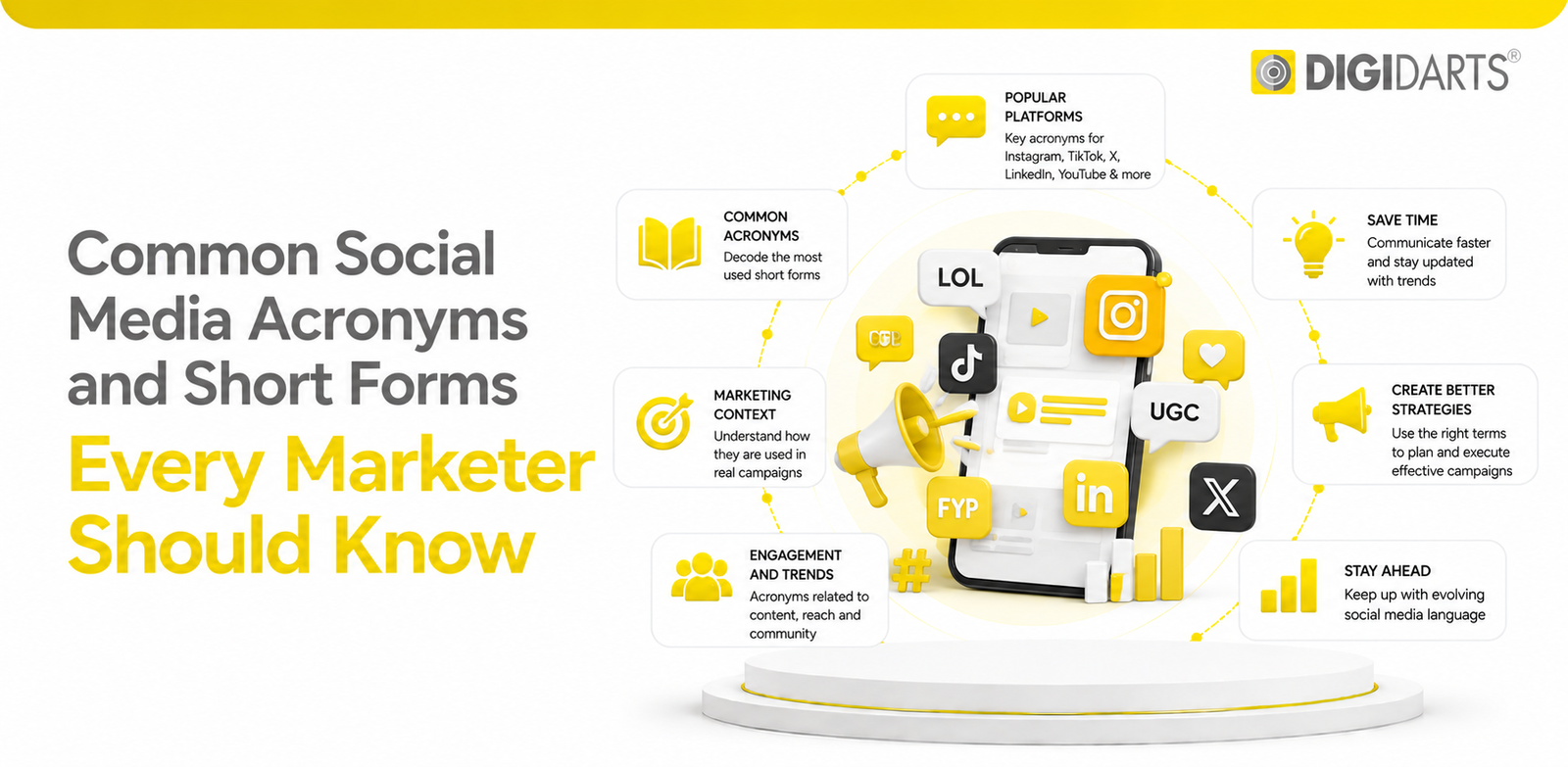
 Social media marketing comes with its own shorthand. Marketers regularly use terms like CTR, CPC, ROAS, UGC, and KPI in campaign dashboards, briefs, and reports. Understanding these social media acronyms helps teams read performance data faster, communicate clearly, and turn numbers into better decisions.
For teams working with Digidarts, knowing these terms makes conversations around paid social, content, media buying, and analytics more productive. If you are evaluating the best performance marketing agency, a shared understanding of marketing terminology makes it easier to discuss objectives and results.
1. Core Social Media and Marketing Terms
Some of the most common social media short forms describe actions, content, and measurement:
- CTA (Call to Action): A prompt encouraging an action, such as “Shop Now,” “Learn More,” or “Sign Up.”
- KPI (Key Performance Indicator): A measurable value used to evaluate progress toward a marketing objective.
- UGC (User-Generated Content): Content created by customers or users, often used to add authenticity to social campaigns.
- SMM (Social Media Marketing): Marketing activities carried out through social platforms to build awareness, engagement, traffic, or conversions.
- SMO (Social Media Optimisation): Improving social content and profiles to increase visibility, engagement, and discoverability.
- ER (Engagement Rate): A measure of audience interaction relative to a defined base, such as reach or followers.
2. Paid Social Media Acronyms Every Marketer Should Know
Paid campaigns introduce another layer of terminology. CTR (Click-Through Rate) measures the percentage of ad impressions that result in clicks, making it useful for assessing how effectively an ad encourages action. Google defines CTR as clicks divided by impressions.
CPC (Cost Per Click) tells marketers the average cost of a click. CPM (Cost Per Mille) refers to the cost associated with 1,000 impressions. CPA (Cost Per Acquisition) focuses on the cost of generating a defined conversion.
Other useful terms include CPL (Cost Per Lead), CPE (Cost Per Engagement), and ROAS (Return on Ad Spend), which compares conversion value with advertising spend. Digidarts uses performance marketing principles to connect media buying decisions with measurable business goals.
3. Content and Creator Marketing Short Forms
Creator campaigns bring another set of social media acronyms into everyday marketing conversations.
KOL (Key Opinion Leader) generally refers to a person with recognised authority within a particular field. KOC (Key Opinion Consumer) commonly describes a consumer whose recommendations can influence purchasing decisions. Meanwhile, GRWM (Get Ready With Me), POV (Point of View), and AMA (Ask Me Anything) describe popular content formats or concepts.
Knowing the terminology helps marketers create clearer creator briefs and align the format, creator profile, and campaign objective before production begins.
4. Engagement and Audience Metrics
Social reporting includes more than likes and comments. Reach generally refers to unique users exposed to content, while impressions count the times content is displayed. Views, saves, and shares provide additional signals about audience interaction.
SOV (Share of Voice) helps marketers understand a brand’s visibility relative to competitors within a defined market or conversation. Context matters. Awareness campaigns may prioritise reach, while conversion campaigns may emphasise clicks and acquisitions.
5. Performance Marketing Acronyms That Connect Social Media to Business Results
Some useful marketing terms sit beyond social platforms. CAC (Customer Acquisition Cost) measures the cost of acquiring a customer. LTV or CLV (Lifetime Value or Customer Lifetime Value) estimates the value a customer can generate over the relationship with a business. CVR (Conversion Rate) measures the percentage of relevant users who complete a desired conversion.
AOV (Average Order Value) shows the average amount spent per order, while ROI (Return on Investment) evaluates returns against relevant costs. Google describes ROI as a ratio based on net profit and costs, highlighting why business economics matter when evaluating advertising outcomes.
For a brand considering the best performance marketing agency, these metrics are often more useful for decision-making than surface-level engagement alone. Digidarts brings together media buying, marketing analytics, creative strategy, CRO, and optimisation.
6. Why Marketers Need to Understand These Acronyms
Knowing terminology helps marketers read reports, understand client requirements, brief creative teams, compare campaigns, and identify optimisation opportunities.
More importantly, marketers should understand relationships between metrics. A high CTR may indicate that an ad attracts clicks, but the campaign still needs valuable conversions. A lower CPC can look efficient until conversion quality or customer value is considered. This is where the best performance marketing agency should connect creative, media, analytics, and business context rather than evaluating isolated numbers.
The goal is not to memorise every abbreviation. It is to understand what each metric tells you, what it leaves unanswered, and which additional data points should influence the next marketing decision.
7. A Quick Social Media Acronym Cheat Sheet
| Acronym | Full Form | What It Tells Marketers |
| CTR | Click-Through Rate | How often users click after seeing an ad |
| CPC | Cost Per Click | Average cost of each click |
| CPM | Cost Per Mille | Cost for 1,000 impressions |
| CPA | Cost Per Acquisition | Cost of a defined acquisition |
| ROAS | Return on Ad Spend | Conversion value relative to ad spend |
| UGC | User-Generated Content | Content created by users |
| CTA | Call to Action | Prompt encouraging a desired action |
Turn Social Media Metrics Into Smarter Marketing Decisions
Understanding social media acronyms turns marketing shorthand into actionable insight. When marketers connect metrics such as CTR, CPA, ROAS, CAC, and LTV, they can evaluate campaigns against real business goals. Digidarts brings that performance mindset to strategy, media, creative, and analytics, helping brands make informed decisions with the best performance marketing agency as a strategic partner for measurable growth.
FAQs
- What are the most common social media acronyms marketers should know?
Common terms include CTR, CPC, CPM, CPA, ROAS, KPI, CTA, UGC, ER, and SOV. Understanding these terms helps marketers interpret campaign performance, communicate clearly, and identify optimisation opportunities. - What is the difference between CPC, CPM, and CPA?
CPC measures the average cost of a click, CPM measures the cost of 1,000 impressions, and CPA measures the cost of generating a defined acquisition or conversion. - What does CTR mean in social media marketing?
CTR means Click-Through Rate. It measures how frequently users click after seeing an advertisement or piece of content, helping marketers assess how effectively the creative encourages audience action. - What does ROAS mean in digital advertising?
ROAS means Return on Ad Spend. It compares the value generated from advertising with the amount spent, helping marketers evaluate campaign efficiency and make informed budget allocation decisions. - Why are social media short forms important for marketers?
Social media short forms make communication faster across briefs, reports, dashboards, and meetings. Digidarts teams can use shared terminology to discuss campaign performance and optimisation more efficiently. - How can marketers use social media metrics to improve campaign performance?
Marketers can compare metrics such as CTR, CPC, CPA, and ROAS to identify weak points, test creative or targeting changes, reallocate budgets, and improve campaigns against defined business objectives.