 Acquiring an app user creates potential value; retention determines how much of that value a business can realise. An install becomes commercially meaningful when a user completes onboarding, returns, engages with core features, purchases, or renews a subscription. For brands investing heavily in acquisition, retention is a performance marketing priority. A best performance marketing agency can connect app advertising, creative strategy, analytics, and optimisation to help businesses acquire users who are more likely to stay engaged and generate long-term value. Digidarts approaches app growth through a performance-led framework that connects acquisition, engagement, retention, and customer lifetime value.
Why User Retention Matters for App Growth
Install volume can hide weak economics. If many acquired users disappear after the first session, rising spend can increase acquisition costs without creating proportional revenue. Retained users can generate repeat purchases, subscriptions, referrals, and richer behavioural data, strengthening customer lifetime value (CLV) and improving acquisition efficiency.
The practical question is which acquisition sources produce users who activate and continue engaging. A performance-led team should compare cohorts by channel, campaign, audience, creative, and post-install event. This shifts optimisation from cost per install toward activation rate, retained-user cost, revenue, and CLV. The best performance marketing agency should help decision-makers connect these metrics rather than treating acquisition and retention as separate dashboards.
How App Advertising Can Influence Retention
Retention starts before installation because advertising sets expectations. Audience targeting determines who enters the funnel, while the proposition and creative influence why they install it. When ad messaging accurately reflects the app experience, users are more likely to arrive with a relevant need and a realistic understanding of the product.
An app advertising agency can strengthen this alignment through intent-based targeting, audience segmentation, search and social campaigns, and creative testing. Digidarts’ mobile app performance framework combines search, social, affiliate, programmatic, and app-store optimisation with attribution and retention considerations. The takeaway is to optimise acquisition for users likely to complete meaningful in-app actions, not installs alone.
From Installs to High-Quality Users
Volume and value require different optimisation signals. A campaign that generates inexpensive installs may underperform if users rarely complete onboarding, purchase, subscribe, or return. Teams should identify behaviours that correlate with downstream value and feed those signals back into campaign strategy.
An app advertising agency can analyse cohorts to find patterns among users who activate quickly, engage frequently, purchase, or deliver stronger CLV. Those insights can influence bidding, audience selection, exclusions, placements, and creative variants. Digidarts’ work with ACKO illustrates the principle: its app acquisition campaign used OEM placements, direct app publishers, and DSPs to generate installs alongside quality leads and policies booked. The lesson is to evaluate acquisition against business outcomes, not download counts alone.
Creative Strategy That Supports Retention
Creative influences the promise users carry into the app. Clear benefit-led messaging, accurate demonstrations, audience-specific hooks, and consistent post-install experiences reduce the gap between expectation and reality. This makes creative testing relevant to retention, especially when teams compare cohorts generated by different messages.
Digidarts’ Creatives for Performance offering includes performance advertisements, audience-targeted ad copy, and platform-optimised content. For app marketers, the principle is to test which creative concepts attract users who later activate or purchase, rather than selecting winners only by click-through rate. Creative, onboarding, and product value proposition should reinforce one another.
Using Data to Connect Acquisition With Retention
Retention-focused optimisation requires a common measurement framework. D1, D7, and D30 retention show whether users continue returning, while activation rate, repeat purchase rate, conversion rate, ROAS, cost per retained user, and CLV reveal commercial quality. Cohort analysis shows whether a channel produces durable users or merely cheap initial conversions.
Marketing analytics makes these signals actionable. Digidarts highlights attribution and analytics across platforms such as AppsFlyer, Branch, and Adjust, supporting analysis across acquisition and retention journeys. The best performance marketing agency should use these insights to reallocate budgets toward campaigns, audiences, and creatives that produce stronger downstream value, while diagnosing where users drop out.
How AI and Automation Can Strengthen App Retention
AI and automation can accelerate decisions when grounded in reliable data. Practical applications include behavioural segmentation, churn-risk identification, predictive audience modelling, automated creative testing, campaign optimisation, personalised messaging, re-engagement, and reporting.
The value comes from finding patterns faster and acting consistently. Marketers can segment users by activation behaviour, identify cohorts showing declining engagement, and tailor re-engagement messages or media audiences. Digidarts has also explored using AI to analyse behaviour, test creatives, and identify users who may be at risk of churn. Human oversight remains important because automation works best when goals, event definitions, and measurement are clearly established.
Building a Retention-Focused App Growth Strategy
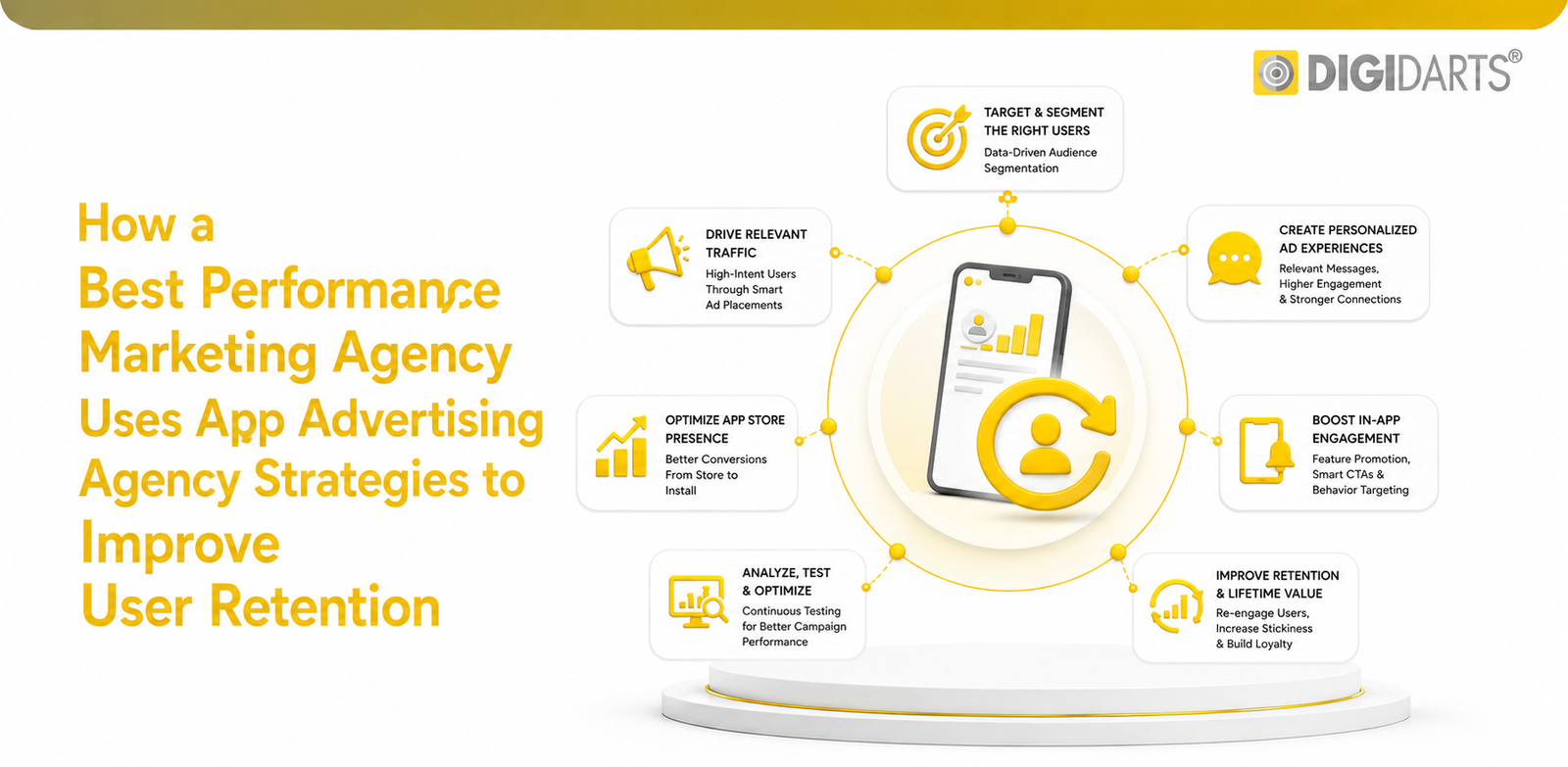
A sustainable app strategy connects the full funnel: precise acquisition brings relevant users in, creative sets expectations, onboarding and CRO reduce friction, analytics identifies valuable behaviours, and re-engagement encourages users to return. Media buying becomes a feedback loop, with retention and CLV informing where incremental budget should go.
For businesses evaluating a best performance marketing agency, the stronger question is whether the partner can connect these disciplines through one measurement framework. Digidarts positions its mobile app performance work around acquisition, retention, engagement, attribution, and bottom-funnel optimisation, providing a broader lens for app growth.
Making User Retention a Performance Priority
Sustainable app growth depends on the quality of relationships built after acquisition. Advertising can attract relevant users, creative can set accurate expectations, analytics can reveal retention patterns, and optimisation can direct investment toward stronger cohorts. Digidarts brings these disciplines together within a performance-led growth approach, helping brands think beyond installs. Choosing the best performance marketing agency means choosing a partner focused on measurable, long-term customer value.
FAQs
1. How does app advertising influence user retention?
App advertising influences retention by attracting users whose needs align with the product, setting accurate expectations, and using behavioural data to optimise campaigns toward users who activate, engage, purchase, or return.
2. What metrics should apps track to measure user retention?
Apps should track D1, D7, and D30 retention, activation rate, repeat purchases, conversion rate, churn, cost per retained user, customer lifetime value, and cohort performance to understand user quality.
3. How can an app advertising agency improve the quality of acquired users?
An app advertising agency can analyse post-install behaviour, identify valuable user segments, refine targeting, adjust bidding signals, test relevant creatives, and optimise campaigns toward actions associated with stronger retention and lifetime value.
4. What is the role of creatives in app user retention?
Creative establishes expectations before installation. Clear, audience-relevant messaging can attract users with stronger product fit, while consistent communication between advertisements, app-store pages, onboarding, and product experience can support engagement.
5. How can performance marketing reduce app user churn?
Performance marketing can reduce churn by identifying high-value cohorts, analysing drop-off points, improving acquisition quality, personalising re-engagement, testing messaging, and shifting budgets toward campaigns that generate stronger post-install behaviour.
6. How can businesses choose the best performance marketing agency for app growth?
Businesses should assess expertise across acquisition, retention, analytics, creative, attribution, CRO, and re-engagement. Digidarts connects these capabilities through a performance-led app growth approach focused on measurable, long-term customer value.